
SMALLab
A joint ASU and Institute of Play project installed at Parsons.
SMALLab in New York Times Magazine
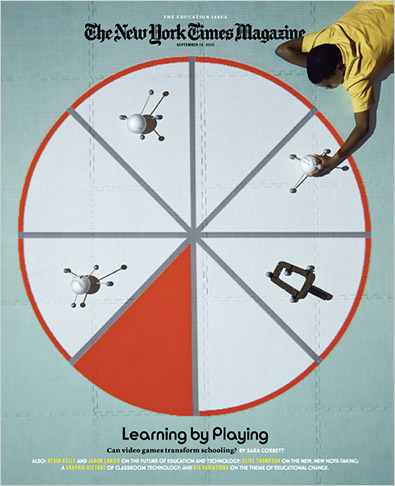 The Education Issue: SMALLab (or a simulation of it) on the front page of the New York Times educational-technology issue.If you picked up a copy of an actual newspaper this weekend (I had to make a special trip for it), you may have seen the cover of the New York Times Magazine with an odd pie chart on it. This is SMALLab, one of the research projects that I've been working with for a long time alongside other Parsons faculty and students.
The whole issue is fantastic and the reference to SMALLab is in the middle of an article about games in education, much of which focuses on Katie Salen's Quest2Learn school. Definitely worth reading.
I thought I'd add a small contribution by breaking down what's on the cover here for posterity. In the top right, Kees is holding one of the mocap controllers that the students made in the classroom at the beginning of last year. It's a big Styrofoam ball with four chopsticks poked into it. Each chopstick is topped with a retroreflective ball, which is what we use to track the position of the controller when we shine infrared light on it from each of the twelve cameras in our OptiTrack system.
We loved these controllers so much that, instead of being temporary tools for teaching about the system, we've kept them for over a year now and have even moved them into Quest's new location with us. If you look very closely, you can see the first name of Claudio Midolo, another of SMALLab's researchers who helped design the controller-building exercise (and helped put this one together--hence deserving his name on it.)
In the bottom right corner is an example of one of the custom controllers we've made to handle a variety of scenarios in SMALLab. This one is a paddle I designed and built for the Raft scenario. It's one of a series of controllers that Claudio and I made, which also included forms that looked like pumps and metal detectors.
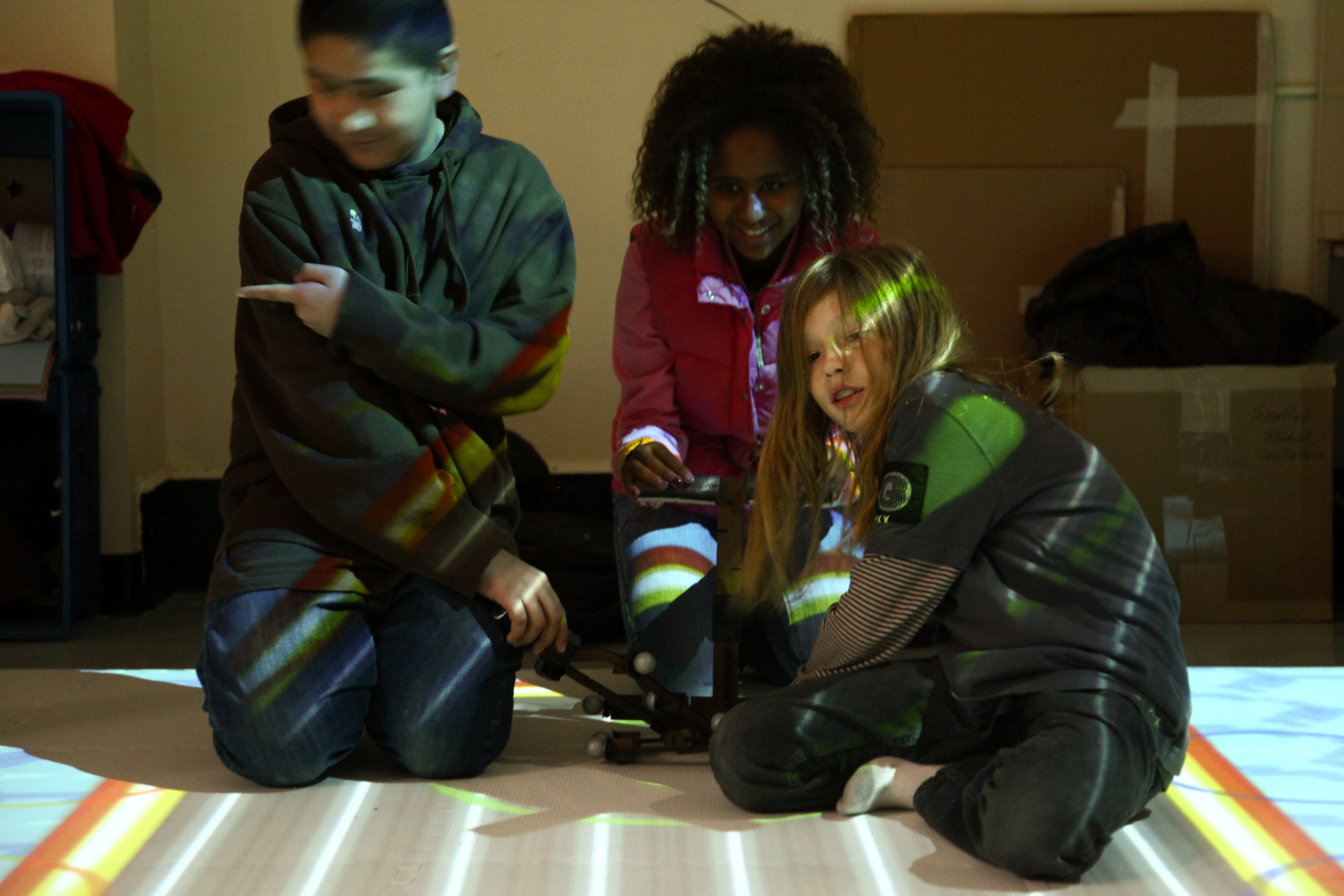
 The Ball Controller: Look close and you'll see Claudio's name!The whole projection image is something Kyle Li put together. It's not actually a real scenario--he built a fully functioning one that is much more interesting to look at (as well as being playable and fun.) But the Times had this gigantic photography rig over the SMALLab mats on the day they shot, so the motion tracking wasn't going to do much of anything with that hulk in the way.
Anyway, that's just of bit of the back story behind the image you see there. We're continuing to develop things with all new controllers and additions to the technology, in many new and exciting subjects, so expect our next SMALLab cover model to be even cooler.
- Mike's blog
- Comments
- Read more


- 128264 reads
Making Fractions Fun, SMALLab Style
Finally coming up for air and getting a little time to blog about some interesting stuff I've been a part of. Just to get started, I wanted to show off a video my colleague Claudio Midolo shot of our fraction game in SMALLab, which we've provisionally dubbed "FracAttack".
- Mike's blog
- Comments
- Read more
- 9920 reads
At GLS 09
Pretty excited to be in Madison--it's a really beautiful town. I'm at GLS 09 for the week to check out the latest and greatest in my little field. I'll be presenting with Dave Birchfield and Katie tonight for the SMALLab poster session, and I'm running a game with Colleen, Eric Zimmerman, and John Sharp using twitter called BACKCHATTER which should be a lot of fun to play.
If you're around, I'm the tall scruffy one in the lime green shirt!
- Mike's blog
- Comments
- 8303 reads
Wavelength "Bucket" Game Prototype
Katie and Kyle haul a violet, orange, and blue color from one side of the space to the other. They have to very carefully match the wavelength of the color by keeping their glowballs the right distance apart as the move across the playing field.
This prototype will be expanded into a more complete game, put the core mechanic seems sound and should drive the learning. Even as the creators of the game, we learned a lot about the properties of light. This is, like the color matching game and the mirror playground part of Gaming SMALLab's Light and Optics curriculum.
- Mike's blog
- Comments
- Read more
- 5819 reads
New Version of Color Mixing Game
This is the latest version of our color mixing game. Here, Kyle and Michie are raising and lowering the red, green, and blue balls to match the color coming out from the center of the floor. The colors get faster as the game progresses--and mistakes shrink the amount of time you have to match!
Very fun and very physical--this will easily wear you out after a few rounds. This is part of the Light and Optics curriculum we are putting together for Katie Salen and David Birchfield's Gaming SMALLab project.
- Mike's blog
- Comments
- Read more
- 6443 reads
The Mirror Playground
Kyle and I are playing with our new mirror playground.
Students can use the playground to test their theories about how mirrors reflect light. We can move and rotate virtual mirrors that reflect a beam of light, as well as add in as many mirrors as we want.
More to come:
- prisms
- angle indicators
- removing mirrors
- obstacles
- targets
- Mike's blog
- Comments
- Read more
- 5810 reads
Color Mixing Game in SMALLab
We created a quick color mixing game prototype using the glowballs and some stock render engines.
The idea is to teach middle-school physics students about how combinations of light can create new colors. Players raise their glowball high or low depending on how much red, green, or blue is needed to match the color sliding down across the floor. Frantic but fun--and only about 20 to 30 minutes worth of work to put together.
- Mike's blog
- Comments
- Read more
- 8194 reads
SMALLab on the Small Screen
The positions of the glowballs, and other information coming from SCREM, can be relayed to a little Nokia N800 palmtop over the WiFi connection.
Tracking is still a little rough, and, as I mention in the video, I think the IR cams are grabbing the N800 a little bit, so we'll need to keep it outside of the area--at least until the tracker is a bit more solid. Still, it should be a handy way to bring in another interface--and other participants--inside SMALLab. In fact, I gave the N800 to James in the office, and he could watch the movements of the balls through the wall.
I'm sure that's useful somehow.
- Mike's blog
- Comments
- Read more
- 5824 reads
3D Buttons and Sliders
Here is a quick video explanation of the HitArea and DragArea render engines.
The engines can track when a pointer enters and leaves them, and the DragArea engine also reports back the pointer's relative position--handy for sliders, etc.
- Mike's blog
- Comments
- 5736 reads
Sonic Slope and the Coordinate Dance
Here are a few more videos from last week's session with ASU. The first is a math game for two players to help students learn about slope through physical and audio interaction. The players can listen to the change in coordinates and then try to determine the right slope based on their positions in three-dimensional space.
There are some issues here with finding the right location for the balls that will prompt some work in the future. Knowing, for example, that you are "on" the right point in the Z-axis may require different kinds of audio cues. One idea we've had is a kind of sonic prompt that fades out when you've hit your mark, but gets louder and louder as you approach the boundary between two integers. This, we hope, will help people visualize where the number 2 and 3 are, rather than floating on the boundary between them and continually triggering the audio sample.
The next video is an improvised dance that the students can choreograph as they each try to reach their X and Y coordinates. This is a variation on the "Coordinate Game" that we had developed the day before. Hopefully, students will get an embodied sense of how the Cartesian system works as they move along in their algebra/geometry units.
It's not quite a game yet, but there's something really fun and compelling about making your own art work (a dance piece) that corresponds to your math assignment.
- Mike's blog
- Comments
- Read more
- 6047 reads
tags
Copyright Mike Edwards 2006-2009. All content available under the Creative Commons Attribution ShareAlike license, unless otherwise noted.
